Slideshow: “Kids on Ice” for Annual Winter Limnology Program
Over the course of four Saturdays, from January 25th – February 15th, Center for Limnology graduate students are instructing a group of middle school
students on the fundamentals of how limnologists do their research on frozen waters.
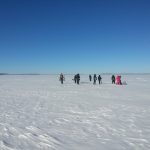
On four different Saturdays in January and February, Winter Limnology gets Madison-area middle school students out on a frozen Lake Mendota.
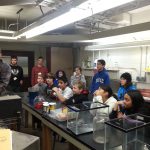
Students start their morning in the CFL’s Wet Lab, learning about the topics they’ll discuss out on the ice.
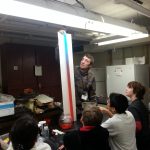
Ben Kraemer demonstrates lake stratification, the process by which a lake separates into a warmer, upper layer of water and a colder, bottom layer thanks to differing densities.
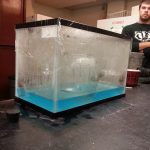
Craig Snortheim stands guard over a model water system. The blue water represents the ocean that, when heated evaporates, condenses then “rains” freshwater on the fishbowl “earth.”
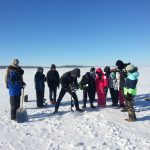
Students watch as Etienne Fluet-Chouinard leans in to the gas-powered ice auger. Drilling holes this year has been a challenge thanks to 14+ inches of solid ice!
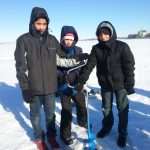
Students pose with a hand auger. (Note: Winter Limnology instructors did NOT make students hand-drill the ice!)
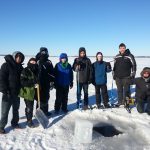
Etienne Fluet-Chouinard and Craig Snortheim with the class after triumphantly drilling through 14 inches of ice
Students peer through the new window into Mendota’s depths.
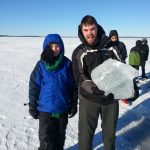
Craig Snortheim and a student pose with their ice-block trophy.
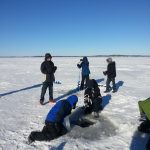
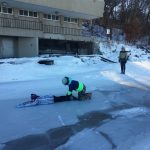
Too fun to go home. Despite the cold and wind, some students just didn’t want to leave the lake. Future limnologists, perhaps?
The program is part of the larger University of Wisconsin’s Saturday Enrichment Program. The program gives Madison-area middle and high school students the chance to come to campus and explore a wide range of interests and academic areas, hopefully empowering them to learn about academic options, career choices, and personal interests.
Students who chose the “winter limnology” track learn what happens to Lake Mendota in during its ice-covered state and also get some insight into what winter life is like for a lot of different organisms. Students first learn about topics ranging from physical processes, to invertebrates, to algae, to fish, to food webs before heading out to peer into Lake Mendota’s frigid depths for themselves. While students are, indeed, exposed to a possible science career path, truth be told, most CFL scientists are working in our heated labs analyzing the data they collected during Wisconsin’s warmer months!
“The first day we went out, it was like a white dust storm with -20 windchills,” recalls instructor and CFL grad student, Luke Loken. It made for a quick outing, he says, and they’re hoping for better conditions this Saturday with collecting aquatic insects and plankton on the agenda.
Luke Loken contributed all images (and a lot of the words) to this post.